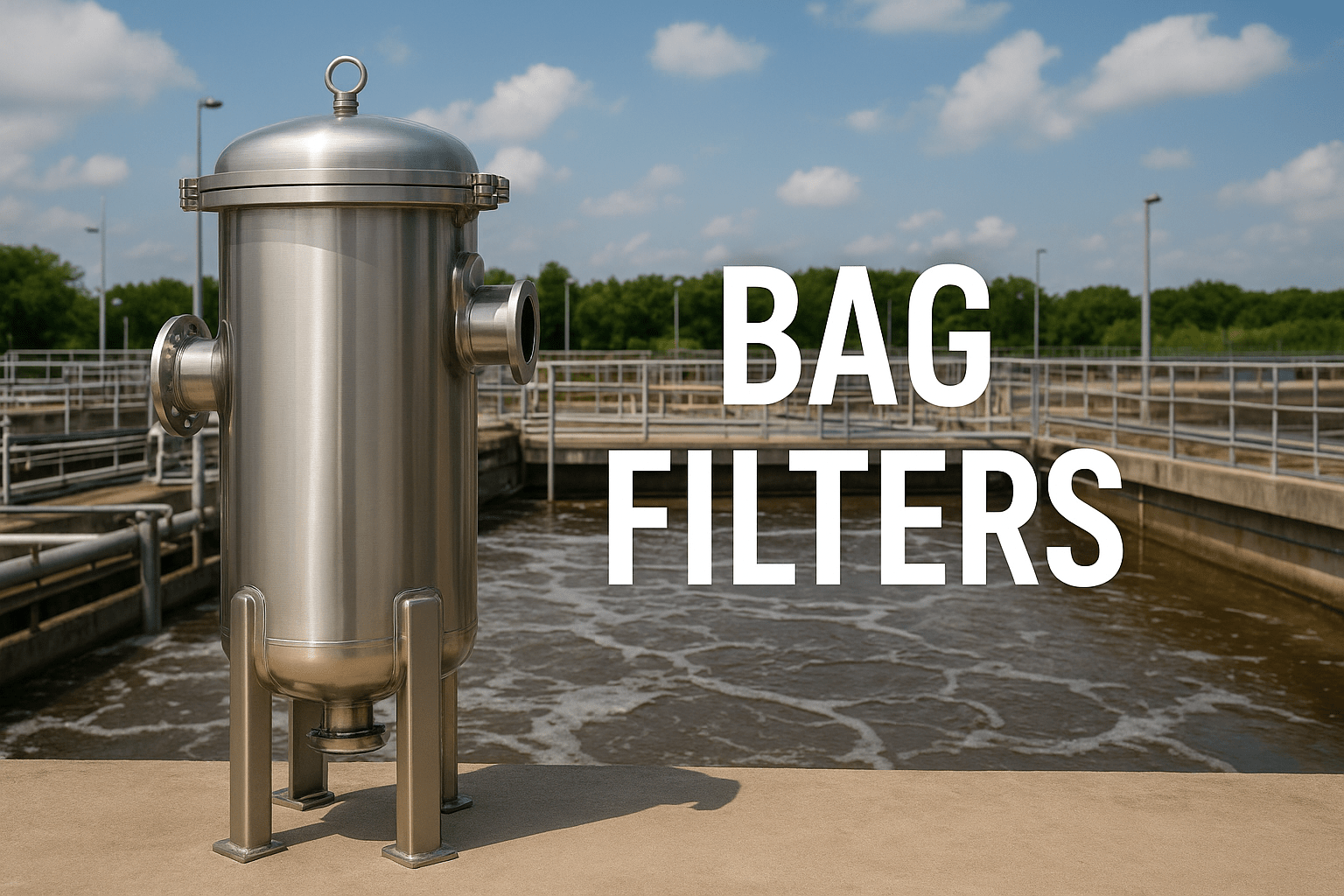
Bag filters are one of the simplest, most versatile, and cost-effective methods for removing suspended solids from wastewater. Despite their straightforward design, they play a crucial role in industrial and municipal treatment systems where clarity, process protection, or regulatory compliance depend on reliable particle removal.
How Bag Filters Actually Work
A bag filter is a pressure-driven, depth-type filtration system that uses a porous woven or layered mesh bag to remove solid particles from wastewater.
- Flow Direction: Wastewater typically enters through the top of the filter housing and passes through the bag (from the inside out).
- Filtration Mechanism: Particles larger than the average (nominal) pore size (distance between the bag mesh or threads) of the bag are trapped on or within the filter media. Tighter meshes or additional layers of fabric are used to remove smaller particles.
- Retention: Smaller particles are captured throughout the depth of the felt material, improving capacity compared to surface-only filters.
- Maintenance: Once differential pressure rises (typically 10–15 psi), the bag is removed and replaced.
Bags are available in micron ratings from 1 to 1,000 µm and materials like polypropylene, polyester, or nylon, depending on the process.
Where Bag Filters Fit in a Wastewater Treatment Plant
Bag filters are generally used for tertiary treatment or process protection, not as a primary solids removal step. Common applications include:
Pre-filtration before cartridge filters, ultrafiltration, or reverse osmosis systems. Polishing after clarifiers or sand filters to capture residual fines. Protection of downstream pumps, instrumentation, or heat exchangers. Industrial discharge treatment where effluent turbidity limits must be met. Batch or side-stream filtration of process wash waters, plating rinse, or cooling tower blowdown.
- Pre-filtration before cartridge filters, ultrafiltration, or reverse osmosis systems.
- Polishing after clarifiers or sand filters to capture residual fines.
- Protection of downstream pumps, instrumentation, or heat exchangers.
- Industrial discharge treatment where effluent turbidity limits must be met.
- Batch or side-stream filtration of process wash waters, plating rinse, or cooling tower blowdown.
They’re ideal when moderate solids loading and infrequent maintenance are expected.
Alternatives and Competitors
While bag filters are simple and effective, several alternatives exist depending on flow rate, solids load, and filtration goals:
| Technology | How It Differs | When to Use Instead |
|---|---|---|
| Cartridge Filters | Rigid pleated media, higher efficiency | Tighter filtration (<1 µm) or sterility required |
| Disc Filters | Automated backwash design | Continuous operation with minimal maintenance |
| Sand or Multimedia Filters | Granular bed, gravity or pressure flow | When large suspended solids loads are present |
| Membrane Filtration (UF/RO) | Very fine pore size (0.01–0.001 µm) | When removing colloids or dissolved solids |
| Automatic Screen Filters | Self-cleaning screen element | Coarse filtration with minimal operator attention |
Bag filters compete most closely with cartridge filters, but are favored for lower operating costs and easier change-outs when extremely fine filtration isn’t required.
Common manufacturers of bag filter vessels and filters include:
Design Criteria for Bag Filters
When selecting or designing a bag filter system, engineers typically consider:
- Flow Rate: Commonly 10–2,000 gpm per housing; multiple housings can be manifolded for higher capacity.
- Solids Loading: High solids require larger bag surface area or staged filtration. Each bag filter has a specific dirt holding capacity (DHC) – this is the maximum amount of Arizona Fine Sand that the filter can hold at 40 gpm at its recommended changeout pressure drop.
- Micron Rating: Determined by required effluent clarity or downstream process tolerance.
- Housing Pressure Rating: Typically 100–150 psi for stainless housings.
- Bag Material Compatibility: Must withstand wastewater chemistry (pH, temperature, solvents, oils, etc.).
- Change-Out Frequency: Ideally every few days to weeks depending on process stability.
- Ease of Access: Top-loading, swing-bolt lids, and lifting mechanisms simplify operation.
Choosing the Right Materials
Material selection depends on both the bag and the housing:
Filter Bag Media:
- Polypropylene: Chemical-resistant, good for general wastewater and oily streams.
- Polyester: Better for hot or abrasive streams.
- Nylon Mesh: Used for straining larger solids.
- Nomex or PTFE: High-temperature or aggressive chemical service.
Filter Housing Material:
- 304 or 316 Stainless Steel: Preferred for municipal or industrial plants.
- Carbon Steel (Coated): Lower cost, but susceptible to corrosion.
- PVC or Polypropylene: For smaller skid systems or non-pressurized applications.
Always confirm compatibility with pH, temperature, and the chemical makeup of the wastewater.
Operations and Maintenance in Practice
Operators typically monitor differential pressure (ΔP) across the bag to determine when to change it. Once ΔP rises above 10–15 psi, performance declines and bypass risk increases.
Maintenance tasks include:
- Inspecting seals and O-rings to prevent bypass. O-rings should be cleaned and lubricated with o-ring grease periodically.
- Replacing bags and disposing of spent media per waste regulations. This can be done in minutes—one of the main reasons bag filters remain popular for secondary polishing.
- Cleaning or flushing the housing periodically.
- Ensuring the pressure relief and venting systems are functional.
Design and Installation for Ease of Use and Safety
To ensure smooth operation and minimal hazards:
- Provide isolation valves on inlet and outlet for safe bag replacement.
- Include a pressure relief valve and vent port for depressurizing before opening. Connect tubing to the vent port to easily direct vented water to a container.
- Orient housings vertically with adequate clearance for lid removal and bag access.
- Drain out all water before removing the bag, otherwise the bag will be very heavy and difficult to remove. A hook installed above the bag filter vessel can aid in bag drainage.
- Use duplex or parallel housings (train A/train B) where continuous operation is required.
- Install differential pressure gauges/sensors for early maintenance indicators.
- Provide non-slip flooring and spill containment around the unit to protect operators.
Good design improves safety, minimizes downtime, and simplifies maintenance scheduling.
Conclusion
Bag filters are a workhorse of wastewater treatment—simple, affordable, and effective for polishing and protection duties. When properly sized and maintained, they deliver reliable solids removal, extend downstream equipment life, and help plants meet discharge standards without the complexity or cost of automated filtration systems.
 Watervana